In the bustling rhythm of modern kitchens, the microwave oven stands as a monument to convenience, a steadfast ally in the daily culinary hustle. Yet, for all its speed and efficiency, this ubiquitous appliance has often been maligned as the enemy of nuance, a brute force tool incapable of the gentle coaxing required for dishes of finesse. Enter the humble egg custard, a classic testament to subtlety and texture. The notion of preparing it in a microwave might seem like a culinary heresy, a shortcut destined for rubbery failure. However, a particular technique, shrouded in a veil of simple plastic wrap, promises not just success, but a revelation. This is the story of achieving a flawlessly smooth, divinely tender steamed egg custard, entirely within the microwave, by mastering the art of covering it with punctured cling film.
The foundation of any great dish is understanding its soul. A traditional Chinese steamed egg custard, or zheng dan geng, is the epitome of simplicity aiming for perfection. Its ideal form is a single, unified, quivering block of silken tofu-like consistency, so tender it melts on the tongue without chewing. It should be entirely free of the unsightly craters and honeycombing that betray overcooking or improper technique. The challenge, whether over a boiling pot or in a microwave, is to cook the egg proteins gently and evenly. Aggressive, uneven heat causes proteins to seize up rapidly, squeezing out moisture and creating a network of tough, spongy holes. The microwave, with its powerful and often erratic energy bursts, is a particularly potent adversary in this delicate dance.
This is where the seemingly mundane kitchen staple, plastic cling film, transforms from a simple storage aid into the most critical piece of culinary equipment. Its role is multifaceted and profound. The primary function is to act as a physical barrier against the number one enemy of a smooth custard: evaporating water. In a conventional steamer, the lid traps a humid environment, but condensation can form and drip onto the custard's surface, marring its perfection with pockmarks and uneven cooking. The cling film creates a hermetically sealed micro-environment over the custard dish, preventing any water from the microwave's atmosphere or from the custard itself from escaping and subsequently falling back in. It maintains a constant, intimate layer of steam right above the mixture, ensuring gentle, uniform heat application.
But the secret, the true genius of the method, lies not just in covering, but in the deliberate act of perforation. Simply sealing the bowl with an unbroken layer of film would be a recipe for disaster. As the custard heats, it expands, and steam builds up vigorously beneath the film. Without an escape route, this pressure would balloon the cling film until it inevitably bursts, or worse, it would forcefully disrupt the delicate setting structure of the eggs, causing it to crack and bubble. The small holes or slits poked into the film provide a controlled, gentle vent for this built-up steam and pressure. It’s a pressure release valve, allowing just enough steam to escape to prevent an explosion while retaining enough humidity to cook the eggs gently. This balance is the absolute key to the technique. Too many holes, and you lose the essential humid environment; too few, and you risk a messy blowout. A few strategically placed punctures with a toothpick or the tip of a knife are all it takes to achieve this equilibrium.
The execution of this technique requires attention to detail from the very beginning. The custard base is a straightforward mixture of eggs and liquid, typically a broth or water, in a precise ratio—often one part egg to one and a half or two parts liquid, by volume. Straining this mixture through a fine-mesh sieve is a non-negotiable step. It eliminates the chalazae (the tough white cords in the egg) and any unbeaten globs of egg white, ensuring a starting liquid of unparalleled smoothness, which is the only path to a finished product of the same quality. Pour this strained mixture into a shallow, microwave-safe bowl or deep plate. A wide, shallow vessel is preferable to a deep, narrow one as it allows for more even and quicker cooking.
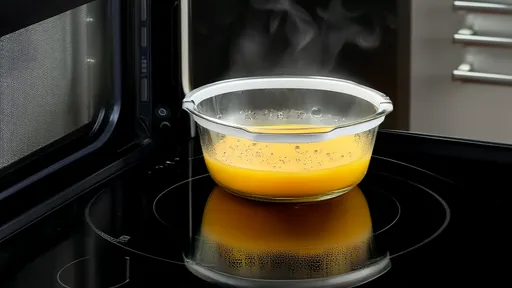
Now comes the pivotal moment. Tear a sheet of microwave-safe cling film—this is crucial, as not all plastics are created equal for this purpose—and stretch it taut over the top of the bowl. Then, with a precise instrument, create a few small vents. Some purists advocate for a single small hole in the center; others prefer three or four tiny holes around the perimeter. The goal is minimal but effective venting. The covered bowl is then placed in the center of the microwave oven. Power is everything. The full, blast-furnace power of a standard microwave is far too aggressive. The custard must be cooked on medium or medium-low power, typically around 50-60% of the oven's total capacity. This lower power setting allows the heat to penetrate the egg mixture gradually, giving the proteins time to set gently rather than seizing up in a panic.
Timing is variable and requires a small degree of intuition. Depending on the microwave's wattage, the quantity of custard, and the chosen power level, cooking can take anywhere from six to ten minutes. It is far better to undercook slightly and check than to overcook. The custard is done when the center is just set but still has a slight jiggle, akin to soft-set jelly. It will continue to cook from residual heat after being removed from the microwave. The final act is to carefully remove the bowl—it will be hot—and peel back the cling film, being mindful of the hot steam that will escape. The revelation is a surface as smooth as a polished stone, unblemished and gleaming. A drizzle of light soy sauce, a few drops of sesame oil, and perhaps a sprinkle of chopped scallions is the traditional, perfect finish.
This method is more than a mere kitchen hack; it is a demonstration of applied food science. It leverages the microwave's speed while cleverly mitigating its inherent drawbacks through a simple physical tool. The punctured cling film technique effectively replicates, and in some ways improves upon, the controlled, humid environment of a professional tiered steamer. It democratizes a dish that once required careful watch over a boiling pot, making it accessible for a quick breakfast, a light lunch, or a comforting late-night snack without compromising an iota on quality or texture. It proves that with understanding and a clever technique, even the most humble appliance can produce results of stunning delicacy and finesse, turning a potential kitchen nightmare into a consistently flawless dream.
By /Aug 20, 2025
By /Aug 20, 2025
By /Aug 20, 2025
By /Aug 20, 2025
By /Aug 20, 2025
By /Aug 20, 2025
By /Aug 20, 2025
By /Aug 20, 2025
By /Aug 20, 2025

By /Aug 20, 2025
By /Aug 20, 2025
By /Aug 20, 2025
By /Aug 20, 2025
By /Aug 20, 2025
By /Aug 20, 2025
By /Aug 20, 2025
By /Aug 20, 2025
By /Aug 20, 2025
By /Aug 20, 2025
By /Aug 20, 2025
