The world of Parisian haute couture has long been shrouded in mystique, where extraordinary craftsmanship meets astronomical price tags. Yet few realize that behind the glittering gowns and show-stopping creations lies an even more astonishing secret: the feather workshops supplying these houses operate on an industrial scale that would make most manufacturers blush. Welcome to the hidden universe where millions of feathers annually transform into objects of desire.
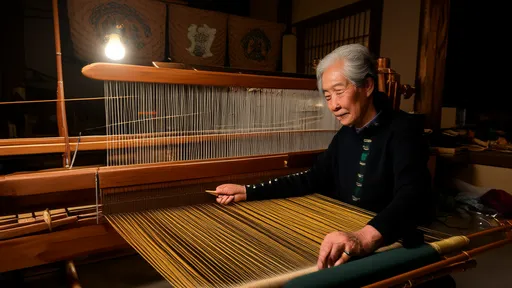
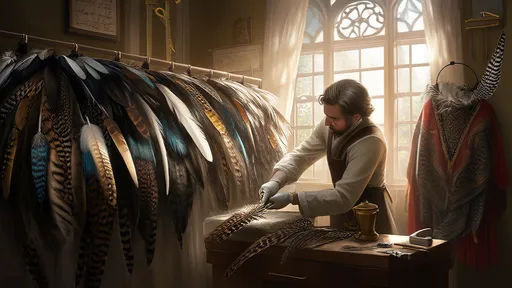
In the unassuming backstreets of Paris's 9th arrondissement, family-run ateliers have been perfecting the art of plumage manipulation for over a century. These are not mere suppliers but guardians of vanishing techniques, where artisans train for decades to master skills that machines cannot replicate. The largest houses process between 800,000 to 1.2 million feathers annually, each individually sorted, cleaned, dyed, and mounted by hand.
What begins as raw material - often ethically sourced ostrich plumes, pheasant tail feathers, or delicate marabou stork down - undergoes alchemical transformation. Master dyers work with archival color formulas dating to the Belle Époque, achieving hues that modern chemistry struggles to match. A single couture piece might incorporate feathers dipped 15 times to achieve perfect ombré, with drying periods between each immersion stretching the process across weeks.
The scale becomes truly staggering when examining the numbers behind iconic creations. That show-stopping feather cape from the latest couture week? Likely required 3,200 hand-placed hackle feathers, each individually steamed into curvature. The ethereal gown that seemed to float down the runway? Probably built upon 18 layers of overlapping goose breast feathers, painstakingly arranged to create optical lightness. These workshops don't deal in dozens or hundreds, but in industrial quantities executed with microscopic precision.
Labor intensity explains why a single feather-adorned couture gown commands prices exceeding €200,000. Veteran plumassiers (feather workers) employ tools unchanged since the 19th century: Japanese fish glue pots, surgical-grade scalpels, and custom brass combs for aligning barbules. Certain techniques like "pointillage" - hand-painting individual feather tips with dye - consume 300 hours per meter of trim. When Chanel acquired legendary feather house Lemarié in 1996, they weren't buying equipment but generational knowledge that takes 20 years to fully absorb.
Modern challenges have forced these ateliers to innovate while preserving tradition. CITES regulations on exotic species mean 85% of feathers now come from farmed or food industry byproducts. Ostrich plumes are harvested during routine farming haircuts, while most "wild" pheasant feathers actually come from game hunters. The real revolution came with synthetic hybridization - combining real feathers with dyed fabrics or laser-cut films to reduce material use while maintaining fantasy.
Perhaps most surprisingly, these million-feather operations remain stubbornly analog. Digital design files arrive from couture houses, but execution relies on hand-drawn templates and physical prototypes. "You can't algorithmize the drape of a peacock feather," explains fourth-generation plumassier Élodie Vauclair. Her workshop's feather library contains over 9,000 categorized samples, each tagged with its optimal use case - a tactile database no computer could replicate.
The future of this rarefied craft hangs in delicate balance. With under 200 master plumassiers remaining worldwide, the knowledge is more endangered than the materials. Yet demand grows exponentially, fueled by red carpet appearances and social media's hunger for the extraordinary. As one workshop owner confided while packaging a shipment of 50,000 iridescent hummingbird feathers (legally harvested before 1970s trade bans): "We're not selling decoration. We're selling the impossible made touchable."
Behind the glamour lies an urgent reality. These workshops represent the last defense against the flattening of luxury into mass-produced sameness. When a single evening clutch requires 400 hours of handwork to embed feathers in perfect Fibonacci spirals, we're witnessing not just craft but high mathematics performed with organic materials. The true cost isn't measured in euros but in the vanishing human capacity to transform nature's fleeting beauty into enduring art.
Next time you see feathers gracing a couture runway, remember: each represents a choice between preservation and extinction. The million-feather economy sustains not just fashion fantasies but living museums of touch - places where human hands still outperform machines, where patience remains the ultimate luxury, and where the marriage of scale and delicacy defies all logic. In our automated age, that paradox alone may be worth preserving.

By /Aug 1, 2025

By /Aug 1, 2025
By /Aug 1, 2025

By /Aug 1, 2025

By /Aug 1, 2025
By /Aug 1, 2025

By /Aug 1, 2025
By /Aug 1, 2025
By /Aug 1, 2025

By /Aug 1, 2025
By /Aug 1, 2025
By /Aug 1, 2025

By /Aug 1, 2025
By /Aug 1, 2025
By /Aug 1, 2025
By /Aug 1, 2025

By /Aug 1, 2025
By /Aug 1, 2025
By /Aug 1, 2025
By /Aug 1, 2025
