In the quiet backstreets of Kyoto’s Nishijin district, where the whispers of history linger in the wooden machiya townhouses, a centuries-old tradition continues to unfold. Here, master weavers dedicate their lives to creating Nishijin-ori, a luxurious textile so intricate that a single square meter can demand over a thousand hours of labor. This is not merely fabric; it is a testament to patience, precision, and the unbroken thread of Japanese craftsmanship.
The story of Nishijin-ori begins in the 15th century, when the district became the heart of Japan’s textile industry. Named after the "Nishijin" (Western Camp) where samurai once gathered, the area evolved into a sanctuary for weavers who served the imperial court and shogunate. Today, the looms still hum with the same devotion, producing silks and brocades that adorn kimono, obi, and modern haute couture. What sets Nishijin-ori apart is not just its beauty but the uncompromising methods behind it. Each thread is dyed before weaving—a technique called sakizome—ensuring colors remain vivid for generations.
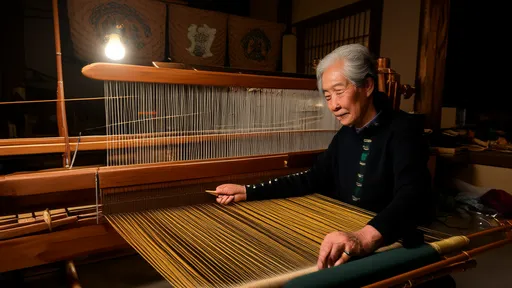
To understand the weight of a thousand hours, one must witness the process. A master weaver, often trained for decades, operates a wooden jacquard loom, a relic of technology that predates computers. The loom’s punched cards, resembling an ancient binary code, dictate the pattern’s every twist and turn. Unlike mass production, where speed is king, Nishijin weaving embraces slowness. A single misstep can unravel weeks of work. The most complex designs, like those featuring gold leaf-wrapped threads or delicate floral motifs, progress at a glacial pace—sometimes just three centimeters a day.
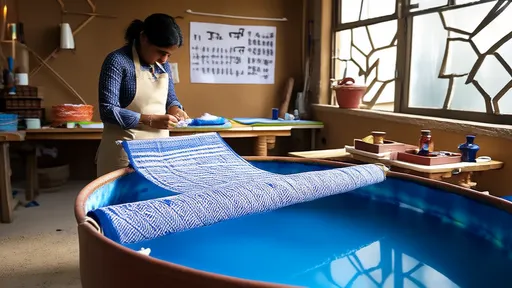
The materials themselves are a pilgrimage of sourcing. Silk threads arrive from artisans in Yokohama, while gold and silver filaments are painstakingly coiled by hand. Even the dyes are derived from natural sources: indigo for deep blues, safflower for radiant reds. These choices matter. They ensure the fabric breathes, ages gracefully, and carries a luminosity synthetic alternatives cannot replicate. When sunlight filters through a Nishijin kimono, the threads seem to ignite, a phenomenon weavers call hikari no odori—the dance of light.
Yet Nishijin-ori’s true cost is measured in human hands. Behind each meter of fabric are specialists: the dyers who calibrate pigments to the season, the thread-twisters who spin silk into ethereal lightness, and the weavers who interpret centuries-old patterns from memory. Many are elderly, their skills irreplaceable. With fewer than 50 workshops remaining, the tradition teeters on a knife’s edge. Younger generations, lured by modern careers, often shy away from the grueling apprenticeship. "We don’t just weave cloth," says 75-year-old artisan Hiroshi Yamamoto. "We weave time itself."
In an era of fast fashion, Nishijin-ori stands as a quiet rebellion. A single obi can cost upwards of $30,000, a price reflecting not just rarity but philosophy. These textiles are heirlooms, designed to outlive their makers. Museums preserve 500-year-old Nishijin pieces with colors still vibrant, a durability that shames disposable culture. For connoisseurs, owning Nishijin is akin to possessing a living artifact—one that demands reverence. "You don’t wear it," explains Kyoto antique dealer Misaki Ito. "You become its caretaker."
The future of Nishijin-ori hinges on adaptation. Some workshops now collaborate with contemporary designers, transforming traditional patterns into handbags or wall art. Others offer public loom experiences, hoping to spark new passion. Still, the essence remains unchanged: this is craftsmanship that cannot be rushed. As the world accelerates, Nishijin weavers continue their slow dance with time, each thread a defiance against oblivion. Their fabric, heavy with hours, asks us to remember what endures.

By /Aug 1, 2025

By /Aug 1, 2025
By /Aug 1, 2025
By /Aug 1, 2025

By /Aug 1, 2025
By /Aug 1, 2025
By /Aug 1, 2025

By /Aug 1, 2025

By /Aug 1, 2025

By /Aug 1, 2025

By /Aug 1, 2025

By /Aug 1, 2025

By /Aug 1, 2025

By /Aug 1, 2025

By /Aug 1, 2025
By /Aug 1, 2025

By /Aug 1, 2025

By /Aug 1, 2025
By /Aug 1, 2025
By /Aug 1, 2025
