The length of a necklace isn't just a matter of measurement—it's a silent conductor of style, an unspoken language that dictates the mood of an outfit. From chokers that whisper rebellion to opera-length strands that exude old-world glamour, the distance between clasp and pendant holds surprising power over fashion narratives. This subtle yet transformative element of accessorizing follows its own set of unspoken rules, where mere centimeters can shift bohemian ease into corporate polish or transform daytime casual into evening drama.
Chokers, sitting tightly at 14-16 inches, have cycled through centuries of symbolism—from Victorian mourning jewelry to 90s grunge revival. Their proximity to the throat creates an intimate focal point, drawing attention to collarbones and jawlines with almost confrontational intensity. Modern iterations play with this tension: delicate gold chains with minimalist pendants offer restrained elegance, while black velvet or chunky metal designs channel punk-rock energy. The choker's magic lies in its ability to make even a basic crewneck tee feel deliberately styled, as if the wearer curated their look with razor-sharp precision.
Princess-length necklaces (17-19 inches) serve as the wardrobe equivalent of a perfectly tailored blazer—versatile enough for daily wear yet capable of sophistication. Falling just below the collarbone, this length interacts beautifully with necklines, creating flattering geometric echoes with V-necks or softening square-cut tops. Designers often use this span for statement pieces: layered coins, oversized pearls, or art-glass pendants gain prominence without overwhelming the frame. Interestingly, jewelry historians note this length dominated postwar fashion, as women sought accessories that complemented the structured shoulders of Christian Dior's "New Look" silhouettes.
The matinee range (20-24 inches) introduces movement into the accessory equation. These necklaces dance between sternum and bust line, catching light with each turn of the body. This length proves ideal for those mastering the art of layering—combining two or three slender chains creates depth without tangling. Fashion anthropologists trace its popularity to the 1920s, when flapper dresses' dropped waists demanded accessories that wouldn't disappear beneath geometric beadwork. Contemporary stylists recommend this length for petite frames, as the vertical line elongates the torso proportionally.
Opera-length necklaces (28-34 inches) embody grandeur in their very drape. Whether worn single-strand or doubled, their liquid descent down the body evokes Golden Age Hollywood starlets and European aristocracy. The physics of these necklaces fascinates—a 32-inch strand of South Sea pearls moves with entirely different weight and sway than an equivalent length of hammered gold links. Modern red carpets see frequent experimentation with this format, from Margot Robbie's layered diamond waterfall at the 2020 Oscars to Zendaya's avant-garde titanium coil necklace that redefined opera-length possibilities.
Beyond these standard categories, contemporary designers play with extreme proportions. Collar necklaces (12-13 inches) sit like metallic turtlenecks, demanding simple clothing backdrops to shine. Rope-length pieces (45 inches or more) invite creative styling—wrapped multiple times, knotted at intervals, or even draped as makeshift belts. The recent trend of "floating" necklaces (18-22 inches with weighted pendants that rest on the sternum) demonstrates how subtle engineering can create optical illusions, making necklines appear more sculpted.
Climate and culture historically influenced preferred necklace lengths—an often-overlooked factor in modern styling. In tropical regions, longer necklaces allowed body heat dispersion, while colder climates saw tighter choker styles that retained warmth. Traditional Balinese jewelry frequently features elaborate multi-tiered designs that cover the entire upper torso, a stark contrast to Scandinavian minimalism's preference for singular, shorter statements. Globalization has blurred these boundaries, yet understanding these roots adds nuance to accessorizing choices.
The psychology behind necklace length selection reveals deeper self-presentation strategies. A 2018 FIT study found that corporate women gravitated toward 18-20 inch lengths during negotiations, subconsciously associating the measurement with authority. Meanwhile, dating profile analyses showed peaks in choker usage among users emphasizing "playful" personalities. Stylists now employ "necklace mapping"—plotting a client's existing collection by length—to identify and fill expressive gaps in their accessory vocabulary.
Material innovation continuously rewrites necklace length possibilities. The development of ultra-lightweight titanium allows for dramatic 30-inch designs that don't pull on the neck. Silicone-embedded chains enable "memory lengths" that temporarily hold coiled positions before springing back. Even 3D printing contributes, with parametric hinges creating transformable necklaces that shift between choker and matinee lengths with a twist. These advancements promise future iterations where a single necklace might fluidly adapt to multiple style personas.
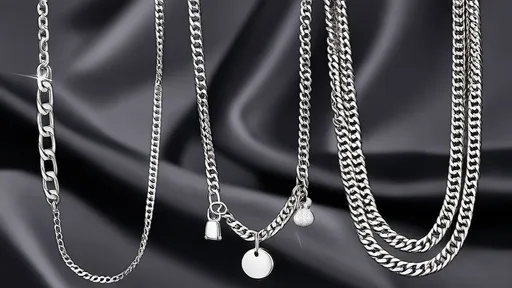
Ultimately, mastering necklace lengths resembles conducting a visual orchestra—each inch adjustment changes the harmony between body, clothing, and accessory. The most striking looks often emerge from breaking conventions: a demure pearl opera necklace paired with a motorcycle jacket, or a chunky choker contrasting a flowing evening gown. As fashion continues dissolving gender norms, necklace lengths follow suit—the same 20-inch silver chain that accents a man's open collar might layer perfectly over a woman's silk camisole. In this fluid landscape, the only true rule remains intentionality: choosing lengths that don't just adorn, but articulate.

By /Aug 1, 2025

By /Aug 1, 2025
By /Aug 1, 2025
By /Aug 1, 2025

By /Aug 1, 2025

By /Aug 1, 2025
By /Aug 1, 2025
By /Aug 1, 2025
By /Aug 1, 2025

By /Aug 1, 2025

By /Aug 1, 2025
By /Aug 1, 2025

By /Aug 1, 2025
By /Aug 1, 2025

By /Aug 1, 2025
By /Aug 1, 2025

By /Aug 1, 2025
By /Aug 1, 2025
By /Aug 1, 2025

By /Aug 1, 2025
